September 12, 2008

How-To: Compile and Install xine-lib 1.1.15 in Debian Lenny and Ubuntu 8.04

Xine is an engine which allows to play audio CDs, DVDs, VCDs, various audio and video formats like AVI, WMV, MOV to list a few. The last version of xine-lib is 1.1.15, released on August 14, 2008.

Installation in Debian Lenny
To compile from source and install xine-lib 1.1.15 in Debian Lenny you'll have to follow the steps below.

1. Enable the sources repositories
Make sure you have a line like the following in your /etc/apt/sources.list file:

deb-src http://ftp.ro.debian.org/debian/ lenny main contrib non-free

Then update the packages list as root:

apt-get update

2. Install the dependencies
As root, type:

apt-get build-dep libxine1

This will install the development packages and the tools needed to compile Xine.

3. Download the source, compile and install
Download the last xine-lib version from here, uncompress it and compile as usual:

./configure
make
make install

Last one as root.

xine-lib should be now installed in /usr/local/lib/.

Installation in Ubuntu 8.04
Ubuntu Hardy comes with libxine 1.1.11, so if you want to update to the latest version, you need to follow the steps above, with the exception of preceding the commands which need root privileges with sudo. For example:

sudo apt-get build-dep libxine1

./configure
make
sudo make install

With your user's password.

Video players using Xine
I can recommend Kaffeine and Xine-UI, both these players use the Xine engine.

Kaffeine 0.8.6

Updated: Sep 12, 2008

September 10, 2008

How-To: Install Video Codecs and DVD Support in Ubuntu/Kubuntu 8.04 'Hardy Heron'

Medibuntu is a project somewhat similar with debian-multimedia.org for Debian, providing packages which are not included in the official Ubuntu repositories due to legal issues. In order to make use of the packages included in Medibuntu (including the non-free video codecs w32codecs and libdvdcss2 for watching ecrypted DVDs), you will only need to follow several easy steps explained below.

1. Add the Medibuntu repository address to /etc/apt/sources.list
Edit as root the /etc/apt/sources.list file (e.g. sudo nano /etc/apt/sources.list or kdesu kate /etc/apt/sources.list) and add the following two lines:

deb http://packages.medibuntu.org/ hardy free non-free
deb-src http://packages.medibuntu.org/ hardy free non-free

2. Update the packages list
Issue the following command:

sudo apt-get update

3. Install the w32codecs and libdvdcss2 packages
To install those two packages, just type in the command:

sudo apt-get install w32codecs libdvdcss2

It should be done now. The codecs will be installed in /usr/lib/codecs/ and the DVD library in /usr/lib/libdvdcss2.so.2.0.8.

Another way to install libdvdcss2 is to first install the package libdvdread3:

sudo apt-get install libdvdread3

And then running the command:

sudo /usr/share/doc/libdvdread3/install-css.sh

As video players, I recommend SMPlayer and Kaffeine, the first using the MPlayer engine, while the latter uses the Xine engine. They both have subtitle support and many powerful features (like remembering video position and settings after closing the application in SMPlayer), and Kaffeine also reads DVD menus.

SMPlayer 0.6.0 running in Kubuntu 8.04

To install either of those, use one of the commands below:

sudo apt-get install smplayer
sudo apt-get install kaffeine

Updated: Sep 10, 2008 (Created: Sep 10, 2008)

August 31, 2008

How-To: Make UT2004 Use OSS on Debian Lenny

Some of us playing Unreal Tournament 2004 may be familiar with the error open /dev/[sound/]dsp: Resource temporarily unavailable. This is usually caused because the sound system is busy (for example, you have an audio player opened, or a paused movie).

The simplest way to get over this problem is to install the alsa-oss package, which contains the aoss wrapper to allow the use of ALSA OSS library. In Debian, type as root:

apt-get install alsa-oss

Then run UT2004 like this:

aoss ut2004

Or:

aoss /usr/local/games/ut2004demo/ut2004-demo

Depending on where your game is installed. The good thing about this is that you can now listen to music in a player separate from the one included in the game and also hear the UT2004 sounds.

August 12, 2008

Banshee 1.2 - 1.x Series Getting to Maturity

The new Banshee 1.2 includes several new features over the last stable release, like the equaliser or the music recommendations panel. The full list of new or improved features is here. For those who didn't hear about Banshee yet, it's a pretty powerful audio player for GNOME which received more and more attention lately, featuring things like a media library, support for Last.fm, podcasts, cover fetching, plugins and many more.

Banshee 1.2.0 playing

I was enchanted to try the so-called 'Amarok Migration' feature, which, according to the official website, lets you import ratings, play counts and podcasts from Amarok. Well, I have Amarok 1.4.9.1 using SQLite but Banshee crashed when I tried to import those using the Media -> Import Media dialogue, already having a media library in Banshee. I tried deleting the file ~/.config/banshee-1/banshee.db and this time the import feature worked flawlessly, and Banshee didn't crash anymore.

Importing the Amarok media library

The equaliser works very well, except that there are no default presets. I think several default presets like 'Rock', or 'Full Bass' would be nice instead of letting the user setting those.

The new equaliser

I was still disappointed to see that the cover fetching plugin doesn't look inside the song's directory for local files like cover.jpg or front.png, but the retrieval of covers from the Internet works pretty well. All of the covers for albums which don't have additions like [2004 Remaster] or [Limited Edition] were correctly fetched.

Plugins

Banshee looks more improved with every version and it's definitely a very promising player. Compared to 1.0.0, this new release it's much more stable (no more crashes when clicking on the Last.fm tab for example), but I think it still needs some work at cover fetching, and the Last.fm integration won't show all the images for recently played tracks. Last.fm changed the layout recently so I'm not sure whether this is Banshee's fault at all.

Last.fm integration - Banshee features song submission too

Although the 1.0 release was also accompanied by a new, professionally designed website, work at the Wiki seems to be still in progress.

Although I'm not a GNOME or GTK fan, I can warmly recommend Banshee to any audiophile using this desktop environment. It's almost full-featured, and stable enough now, the 1.x series showing real signs of maturity now.

About

August 10, 2008

How-To: Compile and Install Banshee 1.2.0 on Debian Lenny

Banshee is a powerful audio player written using GTK, featuring audio and video libraries, support for podcasts and much more. The last version, 1.2, was released on July 30, 2008.

1. Install the necessary dependencies
As root, type:

apt-get install build-essential
apt-get build-dep banshee

For the last one, make sure you have sources repositories enabled in your /etc/apt/sources.list file (there is a line which starts with deb-src).

2. Download the source tarball
Download the source tarball from here, under the Source releases, then change the current working directory to where you saved the archive, and uncompress it:

tar -xjf banshee-1-1.2.0.tar.bz2

Change the working directory to banshee-1-1.2.0, and proceed to the next step.

3. Compile Banshee 1.2.0
In the banshee-1-1.2.0 directory, issue the usual:

./configure
make
make install

The last command as root. Banshee 1.2 should be now properly installed. Run it as banshee-1 from command line or pressing ALT+F2 and typing the name in the run dialogue that appears.

Running Banshee 1.2.0

Most Popular Posts - July

SMPlayer Review - One of the Most Powerful Video Players for Linux
SMPlayer is a complete video player built in Qt 4.4.0 and based on the powerful, open-source MPlayer.


XChat 2.8.6 Review - A Great Graphical IRC Client
XChat is a very powerful IRC client written in GTK who has been around for years and is now feature complete, low on resources, with a powerful scripting interface and support for C plugins.


Why Is It So Hard for Windows Users to Understand That Linux Is Not Windows
A short essay on what makes Windows users who try to switch to Linux have the impression that Linux is harder to learn or use than Windows.

5 Reasons to Use CLI over GUI
First, I must say that using CLI is not always faster, not necessarily. There are tasks which can be done faster and easier using some GUI application rather than typing a whole bunch of commands. But, nevertheless, command line is still very powerful and it's more appropriate to use it for certain tasks.

4 Ways to Rip DVDs on Linux
Review of 4 graphical applications to rip DVDs on Linux: K9Copy, AcidRip, DVD::Rip and Thoggen.


10 Best KDE Applications - Reloaded
Review of 10 KDE applications, a continuation to the 10 Best KDE Applications article I wrote a while ago.


Xfe Review - Wonderful File Manager
Review of the Xfe file manager for Linux written using the FOX toolkit.


12 Web Browsers for Linux - Review
A review on 12 graphical and CLI web browsers for Linux, including Firefox, Konqueror, Kazehakase, lynx and several more.

July 27, 2008

IRC Clients for Linux - A Review

Since I'm an IRC addict and I always liked to spend time learning new stuff on IRC, here is a review of several IRC clients for Linux. Some of them are well-known and popular, like XChat, Konversation or Irssi, and others are not so widely used or known, but nevertheless, they deserve mentioning.

KVirc
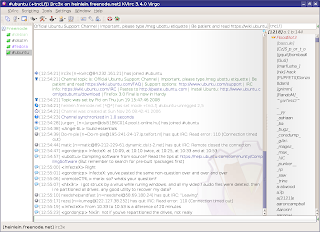
KVirc is a powerful client for KDE focusing on an apealing interface, providing its own scripting language called KVS (KVirc scripting language), with lots of options for configurating it, and much more. Among all the clients I tested, KVirc was the most bloated, trying always to include as many options as possible and be user-friendly in the same time, but sometimes it felt like not all of those were needed. For example, the Ignore As... menu includes all the possible combinations for ignoring a person. I think it would have been wiser to include only 2 or 3 and eventually provide a dialog window so the user can enter it manually, with a brief explanation for how it works.

KVirc 3.4.0 'Virgo'
I also found the CTCP option not useful when on a channel, since if you CTCP VERSION or PING, all the users on that channel will get the CTCP request. On a large channel that can lead to a ban, or lag, and it's just not useful.

Anyway, back to the good stuff that KVirc provides. Each release has a nice codename, like the one in the last version, 'Virgo', with a suggestive picture to emphasise it.

Although I didn't test the scripting language much, it looks pretty much the same as the one mIRC has, so for those who are switching from Windows, KVirc should be a good choice. KVS is accompanied by complete documentation which can be accessed from the Help -> Help Browser menus (you can open it in two different ways, as a separate tab or as a panel). It also supports themes, addons, or the possibility to save different configuration profiles.

KVirc help browser
KVirc scripting menu - the system is somewhat similar with the one of mIRC
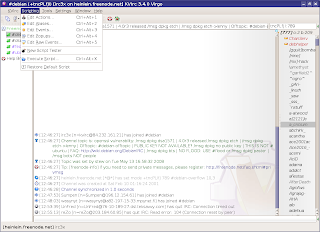
Overall, although this particular version (3.4.0) was a little slow for me, KVirc is complete, powerful and it looks very good.
Official website

Configuring KVirc

XChat
XChat is a very popular graphical client for Linux, including powerful scripting support in Perl, Python, Tcl, C plugins, powerful configurability using /SET variables and many other. XChat is built in GTK, and a version using GNOME libraries, called xchat-gnome, is also available.

XChat usual look
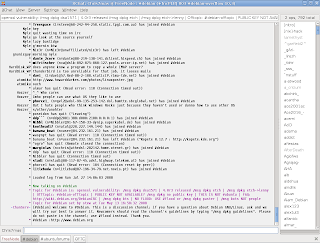
Some of the features I love about XChat besides the powerful scripting support: logging system allowing to name your path and files using date specifiers (like %b for month or %d for day and so on), the interface is simple and clean, yet all the options I need are available using /SET, including the conference mode. The Linux version doesn't receive as much attention like the Windows one (probably because the Windows one is paid), but XChat is already complete.

XChat preferences
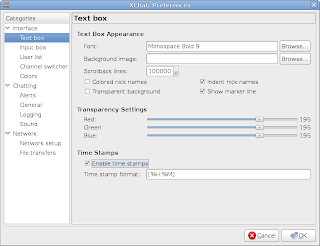
Online documentation is very abundant, and tutorials on how to write scripts and plugins are very helpful and useful.
Official website

Default look for xchat-gnome

Irssi
Irssi is a command line client which includes a simple yet very effective way of navigating through channels/queries. You'll have to read the manual if you use it for the first time, but once you get used to shortcuts (most of them being Emacs-like), Irssi gets pretty easy to use, and shortcuts can be customised too. It supports Perl scripting and the official website contains hundreds of them, can be customised in each and every way using commands explained in detail in the documentation. For me, Irssi wins at all the chapters if it is to compare it with Weechat, Epic4 or TinyIRC.
Official website

Irssi running inside Konsole

Konversation
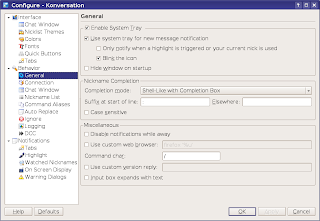
I noticed Konversation received more and more attention over the last years, since it's a client aimed towards persons new to IRC, and strives to be user-friendly. And it succeeds, having all the necessary options in the configuration window. As default though, the interface lacks a toolbar menu, which can be enabled using the Settings -> Show Toolbar menu, and shortcut icons can be added there. As every decent KDE application, Konversation allows editing shortcuts, it can be embedded in the system tray, it includes configurable notifications, it has a basic logging system and an option to load logs in a new tab and perform searches. When joining a new channel or opening a new query, a backlog will be displayed with the last lines of the previous discussion (if any).

Konversation 1.0.1 - 1.1RC1 has been released too
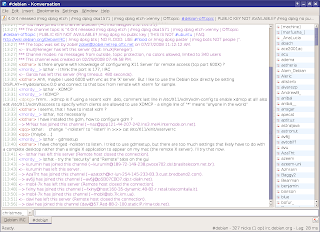
Konversation only lacks event-based scripting, and that's a must-have for a scripting language in my opinion. Otherwise, it comes as default with several powerful scripts, like the now playing script (supporting the major audio and video players for KDE), or a weather script, or system info. The first release candidate for version 1.1 is now available.

Konversation configuration
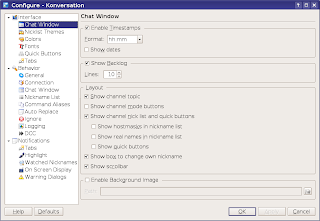
I warmly recommend Konversation to users who want to try IRC for the first time, but XChat or KVirc would be good choices too.
Official website

Default Konversation scripts

Pidgin
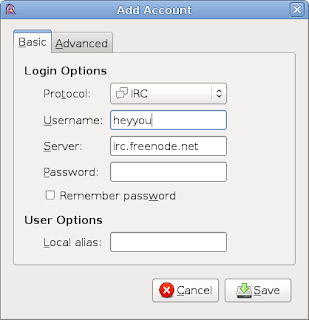
I must say, I rarely use Pidgin or Kopete for connecting to an IRC network, but you can find it useful if you don't care much about having a powerful, dedicated client especially for IRC. Pidgin is widely known for being the GNOME IM (Instant Messaging) client first, but it can also be used as a basic IRC client if you are looking to only get on IRC, without all the options advanced clients provide.
Official website

Adding a new IRC account with Pidgin

Pidgin on IRC

Kopete
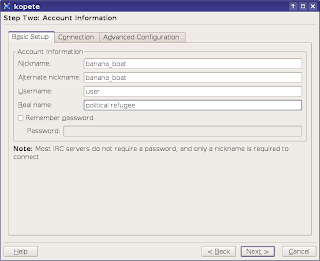
Just like Pidgin, Kopete is the KDE IM client and provides a basic IRC client too. The advantage both Pidgin and Kopete provide is that if you use IM a lot (for example you have both Yahoo and MSN accounts) and want to get on IRC, you can use a single application for it, without the need of opening a new application just to chat on IRC.
Official website

Kopete IRC account

#debian @ Freenode on Kopete

As mentioned above, there are many more clients available, like the popular BitchX, the lightweight Weechat, the classic Epic4 or TinyIRC (official website?) to give a few.